
TVs, monitors, appliances and other fragile products are often protected with EPS foam during shipping. Once these products arrive at large retail distribution centers and are unpacked, bulky end caps, bases and other molded foam packaging become a concentrated waste stream. EPS weighs very little but can quickly fill waste storage areas. When loose foam is transported without volume reduction, a truck can run out of space long before it reaches its weight capacity.
Best Buy reported that it recycled approximately 4.2 million pounds of EPS packaging foam in FY26 and uses EPS densifiers at its distribution centers to reduce the volume of collected material. The processed EPS is then sent to partners for use in new foam products. By handling the material where large volumes accumulate, distribution centers can reduce the space required for storing and transporting loose packaging foam.
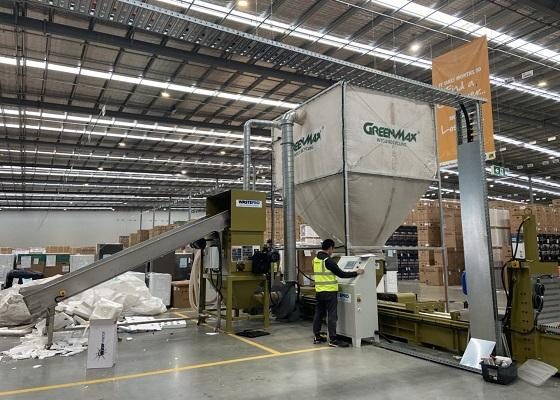
Why Distribution Centers Are Suitable for On-Site EPS Densification
EPS generated at distribution centers differs from foam collected through mixed residential recycling streams. Protective packaging from appliances, consumer electronics and furniture is often removed in designated unpacking areas, where staff can separate EPS from cardboard, plastic film, straps and other packaging materials. Removing these materials before processing helps maintain a cleaner EPS recycling stream.
The concentration of the waste is equally important. Large molded foam pieces may weigh very little, but they can quickly fill a storage area when they are generated every day. As volumes grow, facilities may need more space for temporary storage or more frequent pickups. Reducing the EPS before it leaves the distribution center makes the material easier to store and transport without changing the way products are unpacked upstream.
Choosing a Volume Reduction Method for Distribution Center EPS
Once a distribution center decides to reduce EPS volume on site, the next decision is the processing method. Thermal densification and mechanical cold compaction can both reduce bulky EPS, but they work differently and produce different material forms.
A foam densifier uses heat to soften and densify EPS into a high-density material. A foam compactor uses crushing and mechanical pressure to cold-compact the foam without melting it, producing dense blocks for storage and transportation.
If a facility already works with an EPS recycler, it is worth confirming whether the recycler accepts cold-compacted blocks, thermally densified material or both. Available space, EPS volume and transportation requirements can then be considered alongside the downstream recycling route. This keeps the equipment decision tied to the way the material will actually be handled after it leaves the distribution center.
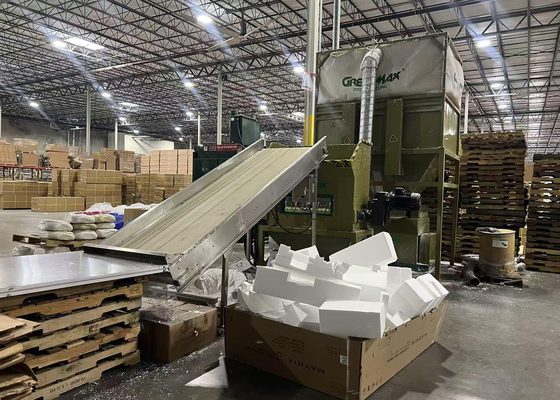
Oversized EPS Packaging Can Become the Real Bottleneck
For distribution centers, equipment capacity is only part of the calculation. Packaging size can have a major effect on how efficiently the system operates.
Small corner protectors and foam inserts are relatively easy to feed, while molded pieces from televisions, refrigerators, furniture and other large products may need to be broken down before entering the machine. Occasional manual size reduction is manageable, but repeatedly breaking and carrying oversized EPS packaging waste can consume considerable labor in a high-volume operation.
This is why the largest pieces generated at the facility matter as much as average EPS volume. If foam comes from several unpacking stations, the distance between those areas and the recycling equipment also affects daily handling. Where material movement or pre-breaking has already become a bottleneck, the feeding arrangement should be considered as part of the equipment configuration.
What Matters in a Distribution Center EPS Operation?
Normal and peak EPS volumes provide a better picture of demand than an average figure alone. Retail and logistics operations may generate significantly more packaging waste during busy periods, when bulky foam can accumulate faster than usual.
The size of recurring EPS packaging and current pickup frequency are also useful indicators. Frequent collections caused mainly by low-density material point to a volume problem, while extensive manual breaking of large molded packaging points to a feeding problem.
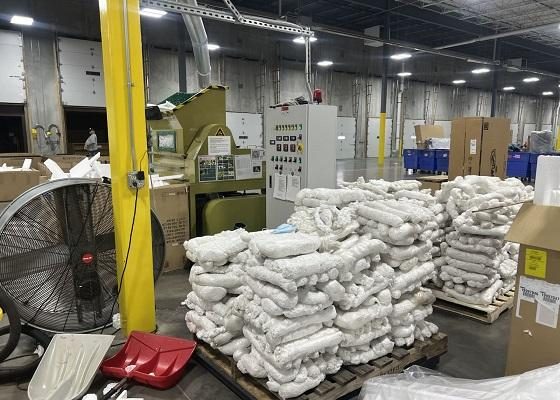
The downstream recycler should be involved before the final equipment decision. Knowing whether the recycler accepts cold-compacted blocks or thermally densified EPS helps define the processing route before equipment is installed.
When Does On-Site EPS Densification Make Sense?
A distribution center that produces only a small amount of EPS may not need its own volume-reduction equipment. If loose foam can be stored without disrupting operations and a recycler already provides reliable collection, the existing arrangement may be sufficient.
The case becomes stronger when EPS repeatedly fills available storage space, pickup frequency increases because of material volume, or staff spend significant time breaking and moving large molded packaging. These conditions help determine whether the main issue is volume reduction, feeding efficiency or both.
For GREENMAX distribution center projects, the starting point is the actual packaging being handled: its size, the amount generated during busy periods, where it accumulates after unpacking and the form accepted by the downstream recycler. A foam densifier or foam compactor can address the volume problem, while the feeding configuration can be adjusted where oversized packaging or multiple unpacking areas are limiting daily handling efficiency.