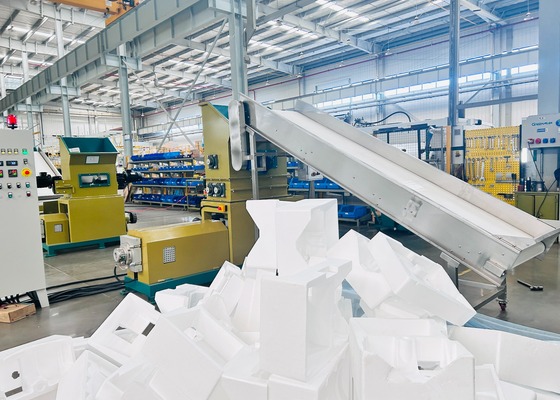
A styrofoam densifier for sale is usually considered for one of two problems: foam that occupies far too much space on site, or foam that is too expensive to move. Understanding which of these actually applies determines whether compaction is enough or whether a melting process is required, and that decision shapes everything about machine selection.
Baled or compacted EPS typically reaches a density around 250 to 400 kg/m³. Hot-melt densification raises that to roughly 600 to 800 kg/m³, which is a meaningful difference once material has to leave the property. Compaction reduces bulk; melting removes air almost entirely. For a facility whose recycler sits a short drive away, the lighter option may be perfectly adequate. For one shipping material across a region, the denser ingot changes the economics of every load.
Hot Melt or Cold Press: Match the Machine to the Route
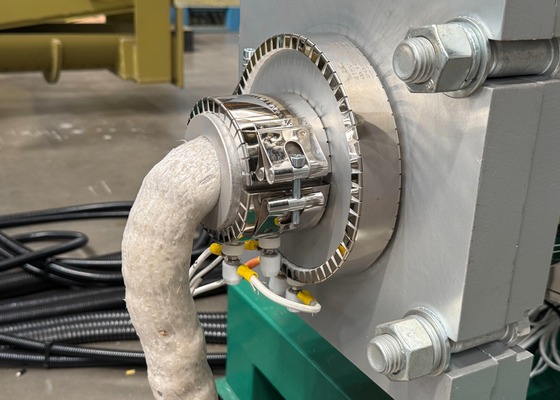
Hot-melt densification becomes worthwhile when loose EPS creates a genuine storage or transport problem. Screw conveying, heating and extrusion turn low-density foam into dense ingots, and for businesses moving recovered material over long distances those ingots make storage and logistics considerably easier to manage. The GREENMAX MARS series uses screw melting technology to reduce EPS volume by approximately 90:1, which suits applications where reducing transport volume is central to the recycling route.
Hot melting is not automatically the right answer for every facility. If a nearby recycler already accepts mechanically compacted EPS blocks and transport distances are short, cold compaction can be sufficient. Hot melting becomes more relevant when storage pressure, longer-distance transportation, or downstream requirements make a denser output worthwhile.
The practical way to settle this is to work backwards from the recycler. Ask what form of material they prefer to receive, what contamination limits apply, whether they can process ingots or only flake, and how they price the material. Those answers usually decide the machine category before throughput is ever discussed.
Transport Distance and Storage Pressure
Distance is where the density difference shows up most clearly. Loose foam is essentially air in a truck, and each trailer load carries only a few hundred kilograms of actual material, so collection costs stay high relative to the weight moved. Once the material is densified the same trailer carries several tonnes, and the cost per tonne of recovered EPS falls accordingly.
Storage pressure pushes in the same direction. Businesses in leased premises often find that loose foam consumes floor area needed for production, and on-site accumulation creates fire-loading and housekeeping concerns that are difficult to manage with light material. Dense ingots stack predictably and can be stored without dominating the warehouse.
Where both conditions are weak, the argument for hot melting weakens with them. It is worth being honest about this, since a compactor costs less to buy and less to run than a melting system, and it solves the problem completely when the route is short and the recycler is flexible.
Hot Melt or Cold Press: Match the Machine to the Route
Hot-melt densification becomes worthwhile when loose EPS creates a genuine storage or transport problem. Screw conveying, heating and extrusion turn low-density foam into dense ingots, and for businesses moving recovered material over long distances those ingots make storage and logistics considerably easier to manage. The GREENMAX MARS series uses screw melting technology to reduce EPS volume by approximately 90:1, which suits applications where reducing transport volume is central to the recycling route.
Hot melting is not automatically the right answer for every facility. If a nearby recycler already accepts mechanically compacted EPS blocks and transport distances are short, cold compaction can be sufficient. Hot melting becomes more relevant when storage pressure, longer-distance transportation, or downstream requirements make a denser output worthwhile.
The practical way to settle this is to work backwards from the recycler. Ask what form of material they prefer to receive, what contamination limits apply, whether they can process ingots or only flake, and how they price the material. Those answers usually decide the machine category before throughput is ever discussed.
Transport Distance and Storage Pressure
Distance is where the density difference shows up most clearly. Loose foam is essentially air in a truck, and each trailer load carries only a few hundred kilograms of actual material, so collection costs stay high relative to the weight moved. Once the material is densified the same trailer carries several tonnes, and the cost per tonne of recovered EPS falls accordingly.
Storage pressure pushes in the same direction. Businesses in leased premises often find that loose foam consumes floor area needed for production, and on-site accumulation creates fire-loading and housekeeping concerns that are difficult to manage with light material. Dense ingots stack predictably and can be stored without dominating the warehouse.
Where both conditions are weak, the argument for hot melting weakens with them. It is worth being honest about this, since a compactor costs less to buy and less to run than a melting system, and it solves the problem completely when the route is short and the recycler is flexible.
Confirm the Route Before Comparing Machines
Once capacity and budget are on the table, the remaining question is where the material will actually go. A useful equipment recommendation requires more than a daily tonnage figure, because the same volume of EPS supports very different machine choices depending on the disposal route behind it.
Photos of the EPS show shape and approximate size at a glance. Combined with daily or weekly volume, planned operating hours and the intended destination of the processed material, they make it far easier to determine whether hot-melt densification is suitable and what processing capacity is required.
For businesses comparing a styrofoam densifier for sale, the most suitable machine is not necessarily the largest one or the one with the highest densification ratio. It is the machine that fits the EPS waste, the operating schedule, the transport conditions and the downstream recycling route taken together.
If a specific EPS waste stream is already identified, photos of the material, approximate dimensions and daily volume are usually enough to begin an initial equipment evaluation.