
The challenge: bulky EPE waste, transport headaches, and rising disposal spend
During production, the two sites generated EPE packaging foam in high volumes. The team previously relied on a local recycler, but that partner later went bankrupt. With no immediate outlet, the foam started going to disposal—reportedly costing up to $7,000 per month in garbage fees, plus additional storage costs.
Operationally, the material was also difficult to move. The site described sending trucks daily to transport foam waste (around 4,000 lbs per day) and estimated as much as 560,000 lbs of EPE foam waste per month, depending on production.
Why GREENMAX: a practical path to PE foam recycling
Quanta's decision makers began actively evaluating PE foam recycling solutions and found GREENMAX while researching the U.S. foam recycling market. After several months of technical discussions, the Tennessee plant moved first and ordered a GREENMAX M-C200E PE foam densifier.
The solution: GREENMAX M-C200E PE foam densifier (compression up to 90:1)
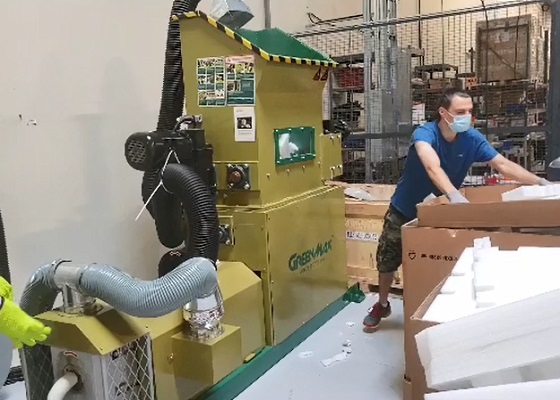
The M-C200E was customized for Quanta's workflow and designed to densify PE foam (EPE). The equipment can also process EPS, giving the plant flexibility when inbound foam streams vary. According to the case information, the densification ratio can reach up to 90:1—turning bulky foam into a far more manageable output.
Operational highlights
- On-site densification to reduce storage footprint and keep production areas clear.
- High volume reduction (up to 90:1) to make transport and downstream handling more economical.
- Stable daily operation that fits manufacturing rhythms.
Results: 250,000+ lbs recycled and $42,000+ landfill cost avoided
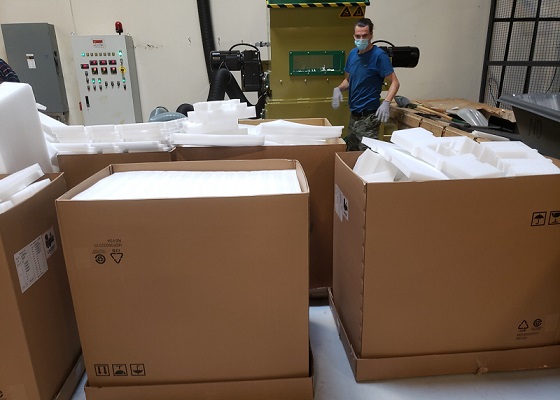
Over more than half a year of operation, the Tennessee plant reported recycling over 250,000 lbs of EPE foam waste, while saving more than $42,000 in landfill-related costs. The site also reported a cleaner work area and improved operational efficiency.
Expansion timeline: one site proves the model
- October 2020: the California plant ordered a second GREENMAX PE foam densifier after the Tennessee rollout.
- By 2024: Quanta purchased three additional PE foam densifiers for different warehouses.
Key takeaways for manufacturers handling EPE packaging
- When recycling outlets are unstable, on-site densification creates control and consistency.
- A PE foam densifier turns low-density packaging into a format that’s easier to store and ship.
- Standardizing a repeatable process across locations simplifies training and scaling.
FAQ
What is a PE foam densifier used for?
A PE foam densifier reduces the volume of low-density EPE/PE foam so it's easier to store, transport, and route into PE foam recycling channels.
Can the M-C200E handle EPE packaging foam from electronics manufacturing?
Yes. In this case, Quanta used a GREENMAX M-C200E PE foam densifier to process EPE computer packaging foam on-site.
How does densification help reduce waste management costs?
By reducing foam volume dramatically, plants often need fewer pickups, less storage space, and can avoid a portion of landfill/disposal spend.
How do I choose the right foam densifier?
Start with your foam type (EPE/EPS), daily volume, available space, staffing, and downstream outlet requirements—then match to the right model size and configuration.
Talk to GREENMAX about your PE foam recycling setup
If your facility generates EPE packaging foam, share your volumes, available space, and operational constraints. GREENMAX can recommend a PE foam densifier configuration that fits your workflow and helps you stabilize PE foam recycling on-site.