
EPS waste management is a growing challenge for food distributors, cold-chain companies and produce wholesalers that handle large volumes of foam packaging every day. Expanded polystyrene is widely used to protect temperature-sensitive products during storage and transportation, but once discarded, its lightweight and bulky structure can quickly fill dumpsters and storage areas, increasing waste collection frequency and handling pressure.
Because EPS takes up significant space while weighing very little, dumpsters can fill quickly and storage areas may become crowded. For companies generating foam packaging every day, effective EPS waste management is therefore not simply about removing waste - it also involves reducing volume, improving handling efficiency and finding a more practical way to manage recyclable material.
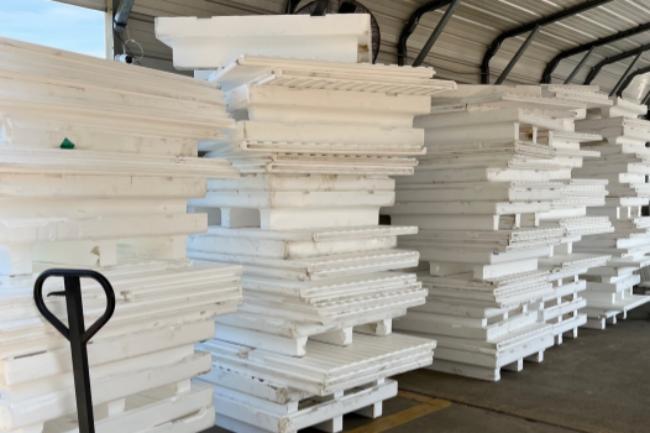
Why EPS Packaging Waste Is Difficult to Manage
Unlike many compact forms of commercial waste, EPS packaging waste contains a large amount of air.
This means even relatively small quantities by weight can occupy considerable warehouse and dumpster space. Businesses may consequently face more frequent waste collection, inefficient storage and additional handling requirements.
For food distributors and cold-chain businesses, these issues can become more significant as shipment volumes increase.
An effective EPS waste management strategy should therefore address several key challenges.
1. Reduce the Volume of Bulky EPS Waste
The first priority is usually volume reduction.
Loose EPS packaging can quickly fill waste containers. Processing the material into a more compact form significantly reduces the space required for storage.
This makes EPS waste reduction especially important for businesses that receive packaged goods on a daily basis.
Reducing material volume can also make internal waste handling more organized and help businesses use warehouse space more efficiently.
2. Reduce Manual Handling of Large Foam Pieces
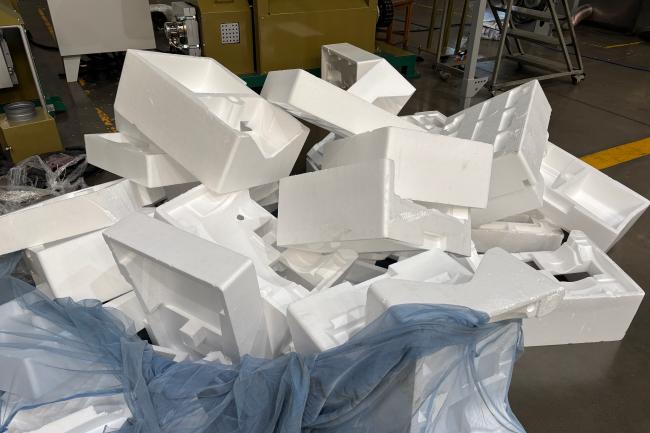
Large EPS boxes and protective packaging may require employees to break the material into smaller pieces before further processing.
When waste volumes are relatively low, manual handling may be manageable. However, as business volumes increase, employees may spend more time preparing and feeding foam into recycling equipment.
Pre-processing equipment such as shredders can help break large pieces of EPS packaging waste into smaller and more uniform material.
This reduces repetitive manual work and prepares the material for more continuous processing.
3. Improve Storage and Feeding Efficiency
Another important part of EPS waste management is controlling the flow of material.
Instead of requiring employees to continuously feed foam by hand, temporary storage and automatic feeding systems can help maintain a more stable supply of processed EPS.
A typical process involves shredding large pieces of EPS packaging into smaller, more uniform pieces, temporarily storing the processed material, and then automatically feeding it into the volume reduction equipment. This helps create a more continuous workflow while reducing the need for frequent manual handling.
This type of configuration can be particularly useful when the quantity of EPS generated by a facility increases.
4. Consider the Destination of Recovered EPS
Effective EPS waste reduction should not stop after the material becomes smaller.
Businesses should also consider what happens to the recovered EPS after processing.
Compacted material is easier to store and transport than loose foam and can potentially enter downstream recycling channels rather than being handled entirely as ordinary waste.
This creates a more practical approach to managing EPS generated during daily business operations.
A Practical Example From the Food Distribution Industry
A refrigerated food and produce distributor in Louisiana, USA, successfully improved its EPS handling through an EPS recycling project with GREENMAX.
The company was spending approximately $1,000 per month on waste disposal.
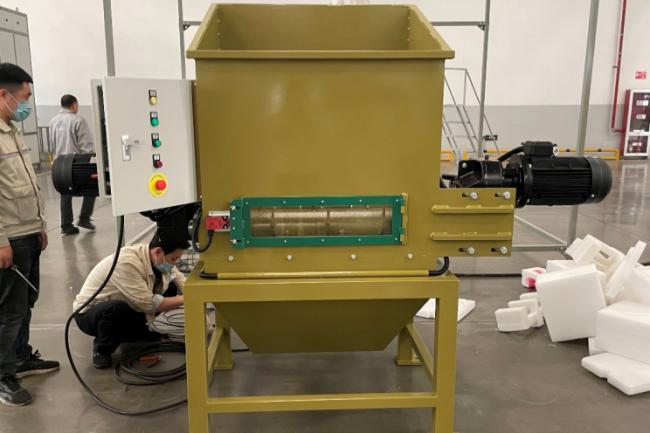
After introducing the GREENMAX M-C200E foam densifier, the company was able to process its bulky EPS on-site. As its material volumes later increased, additional shredding, storage and automatic feeding equipment were introduced to improve handling efficiency.
The project demonstrates an important principle: an EPS waste management strategy can evolve as a company's waste volume and operational requirements change.
GREENMAX Solutions for EPS Waste Management
Different businesses generate EPS in different quantities and forms.
Food distributors may handle packaging boxes, appliance manufacturers may generate protective foam, while furniture and logistics companies can produce large quantities of EPS cushioning material.
For this reason, an effective approach should consider:
·Daily EPS generation volume
·Available storage space
·Labor requirements
·Material size
·Processing frequency
·Transportation requirements
·Downstream recycling opportunities
GREENMAX provides customized EPS recycling solutions to help businesses improve the handling of bulky EPS waste.
If your business generates large quantities of EPS packaging and is looking for a more efficient way to reduce waste volume and improve material handling, contact GREENMAX to discuss a suitable solution.